Practical2026-03-05
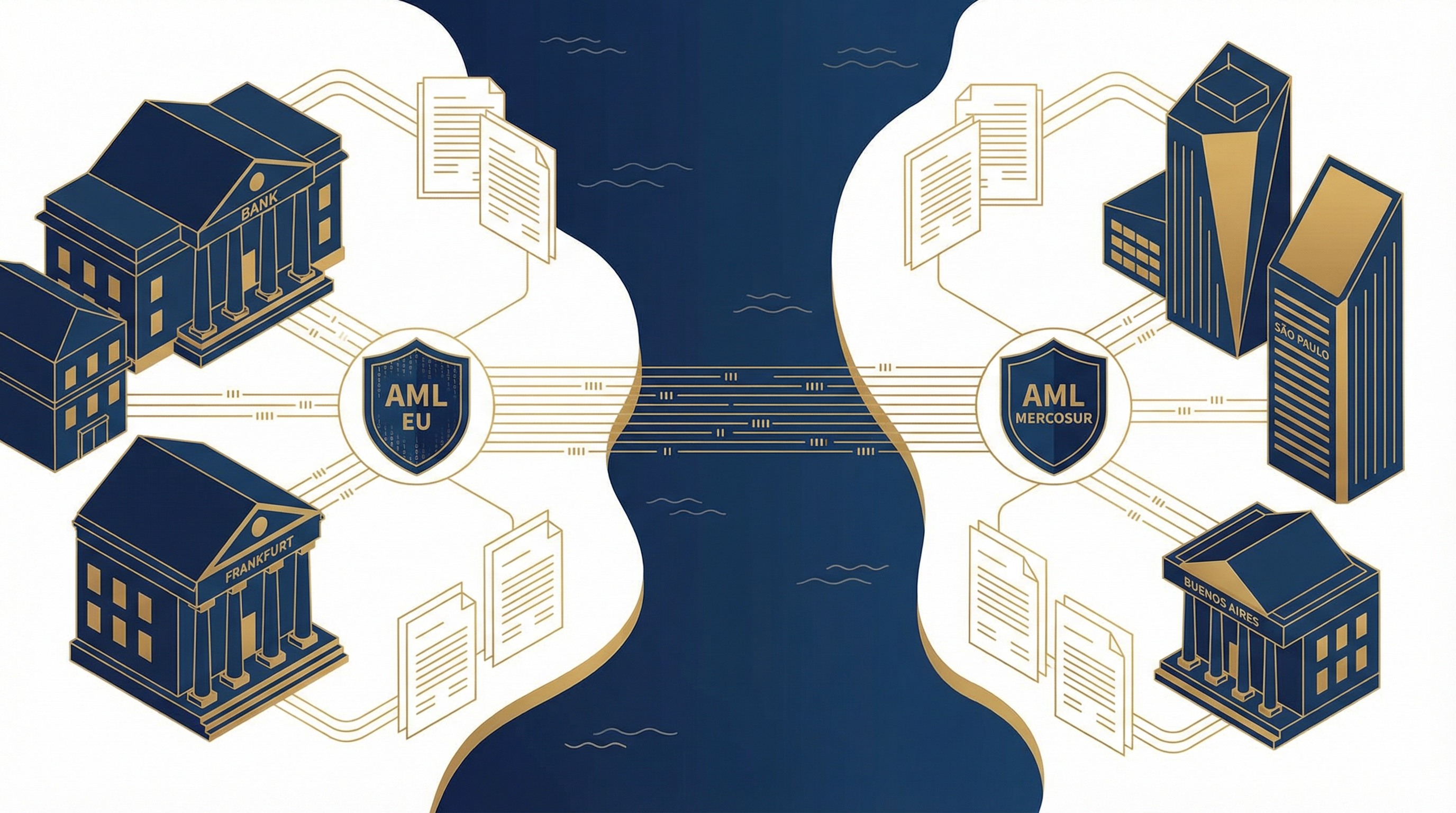
The intensification of trade between the European Union (EU) and MERCOSUR, catalyzed by their trade agreement, opens up considerable economic prospects. However, this growth is accompanied by increased exposure to the risks of money laundering and terrorist financing (AML/CFT). For companies engaged in transatlantic trade, implementing a robust AML compliance program is no longer an option, but a legal and operational necessity. Navigating the complex regulatory frameworks of both blocs is essential to secure transactions and avoid heavy penalties.
This practical guide details the key AML regulations in the EU and MERCOSUR countries, Know Your Customer (KYC) requirements, beneficial ownership identification, and the concrete steps to build an effective compliance program.
Companies operating between the EU and MERCOSUR must juggle several layers of AML regulations. Although there is a convergence towards the standards of the Financial Action Task Force (FATF), significant national differences remain.
In the European Union: The EU's AML framework is undergoing a major transformation with the introduction of a new legislative package aimed at harmonizing rules across the 27 member states. Key elements include:
* The 6th Anti-Money Laundering Directive (AMLD6): Harmonizes the definition of money laundering offenses and toughens penalties. * The Transfer of Funds Regulation (TFR): Imposes traceability requirements for transfers of crypto-assets. * The new Anti-Money Laundering Authority (AMLA): A new European agency that will directly supervise the riskiest financial institutions and coordinate national supervisors.
These new rules strengthen Customer Due Diligence (CDD) obligations and emphasize a risk-based approach.
In MERCOSUR: Each MERCOSUR member country has its own legislation and financial intelligence unit (FIU):
* Argentina: The *Unidad de Información Financiera* (UIF) is the central authority. The legislation has recently been strengthened to further align with FATF recommendations. * Brazil: The *Conselho de Controle de Atividades Financeiras* (COAF) oversees compliance. Brazil has a sophisticated regulatory framework, particularly in the financial sector. * Paraguay and Uruguay: These countries also have AML frameworks in place, supervised respectively by the *Secretaría de Prevención de Lavado de Dinero o Bienes* (SEPRELAD) and the *Unidad de Información y Análisis Financiero* (UIAF).
Companies must therefore comply with both EU rules (especially if they are based or conduct transactions there) and the specific regulations of the MERCOSUR country with which they trade.
The pillar of any AML program is the Know Your Customer (KYC) process. This involves verifying the identity of your business partners (customers, suppliers, distributors) and assessing the risks they present. Due diligence measures can be of three levels:
For EU-MERCOSUR trade, enhanced due diligence may be required more frequently, given the inherent risks of international trade and perceptions of corruption risk in some countries.
One of the most critical requirements is the identification of the Ultimate Beneficial Owners (UBOs) of your business counterparties. A UBO is the natural person who ultimately owns or controls a legal entity. Criminals often use complex corporate structures (shell companies, trusts) to hide their identity.
The EU has established central beneficial ownership registers in each member state. Although public access to these registers has been restricted by a decision of the Court of Justice of the EU, obliged entities (such as banks and many companies) retain access to them to fulfill their due diligence obligations. In MERCOSUR, the availability and transparency of this information may vary, making the task more complex. Companies often have to resort to detailed questionnaires and specialized data providers to reconstruct the ownership structure.
International trade requires rigorous screening of all parties to a transaction against international sanctions lists. These lists are published by bodies such as the EU, the United Nations, and the US Office of Foreign Assets Control (OFAC). A transaction involving a sanctioned person or entity can result in massive fines and criminal prosecution.
Screening must be carried out not only on your direct counterparties, but also on beneficial owners, the ships transporting the goods, the banks involved, etc. This process must be continuous, as sanctions lists are updated frequently.
For companies engaged in EU-MERCOSUR trade, an AML compliance program should include the following elements:
Summary Table of Actions:
| Step | Objective | Key Actions | | :--- | :--- | :--- | | 1. Risk Assessment | Understand the company's exposure | Analyze customers, products, geographies. Document findings. | | 2. Policies and Procedures | Standardize the response to risks | Write an AML policy and SOPs for KYC/CDD. | | 3. Compliance Officer | Ensure oversight and accountability | Appoint a Compliance Officer with the necessary authority. | | 4. Technology | Automate and strengthen controls | Invest in screening and monitoring software. | | 5. Training | Create a culture of compliance | Regular and targeted training sessions for staff. | | 6. Audit | Verify program effectiveness | Schedule annual or biennial independent audits. |
AML compliance in the context of EU-MERCOSUR trade is a complex but unavoidable challenge. It requires constant vigilance, a deep understanding of the regulations on both sides of the Atlantic, and an investment in robust processes and technologies. Far from being a mere administrative burden, a strong AML compliance program is a competitive advantage. It protects the company from financial and reputational risks, strengthens the trust of business partners and financial institutions, and ensures the long-term sustainability of business operations in this increasingly interconnected and vital economic corridor.
For a personalized analysis of your situation, do not hesitate to contact us. The first consultation is free and without obligation.
Related tool
Compliance tools
Join professionals who follow MERCOSUR news. 1 email per week, unsubscribe in 1 click.
Receive our regulatory monitoring and exclusive analyses directly in your inbox.