
Home/News/Practical
Practical 2026-05-29 9 min

Exporting to Europe from MERCOSUR: guide for Latin American companies

Alessandro Brenci

Attorney at law, international trade law expert

Exporting to Europe from MERCOSUR: guide for Latin American companies
Share

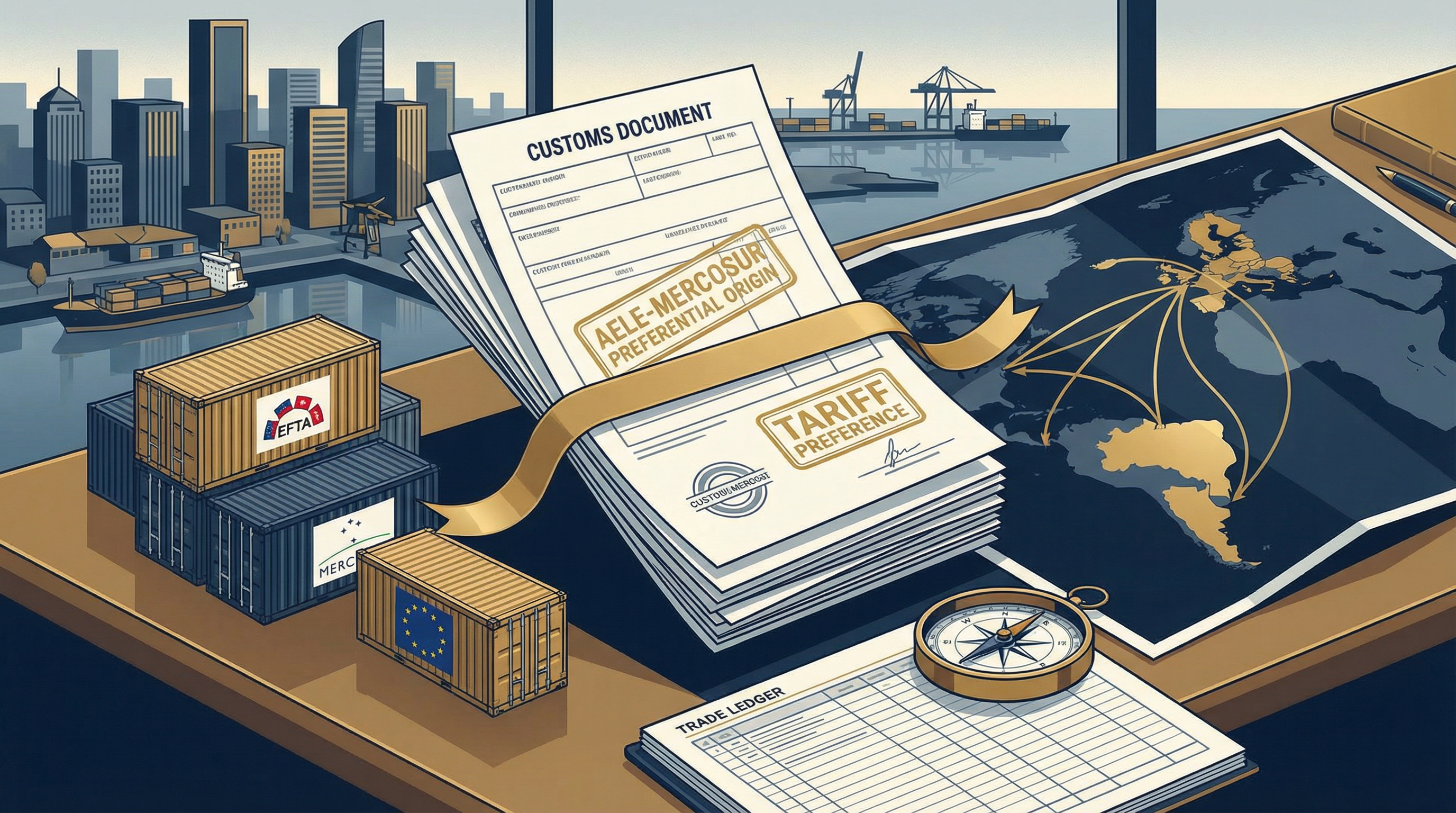
Exporting to Europe from MERCOSUR: A Guide for Latin American Companies\n\n### Introduction: A New Era of Opportunities for MERCOSUR Exporters\n\nThe provisional application of the interim Trade Agreement (iTA) between the EU and MERCOSUR has, rightly, been widely analyzed from the perspective of European companies. However, this agreement represents an equally profound transformation for companies in Argentina, Brazil, Paraguay, and Uruguay seeking to access the world\'s largest single market. Selling in the European Union is no small feat. It is a demanding, regulated, but also extremely lucrative market. This practical guide is designed for MERCOSUR exporters, whether they are established players or newcomers. It aims to demystify the main requirements and to map out a roadmap for turning the promises of the iTA into concrete business successes.\n\nThe agreement does more than just reduce the customs duties that MERCOSUR products pay upon entry into the EU (for example, from 9.6% to 0% for Brazilian footwear over several years). It also aims to simplify procedures and improve regulatory cooperation. But to benefit from it, careful preparation is essential. This guide focuses on four essential pillars: market access and CE marking, food safety (SPS), customs procedures and obtaining the EUR.1 certificate, and the practical steps to get started.\n\n### Pillar 1: Market Access and the \"Sesame\" of CE Marking\n\nFor many manufactured products, access to the European market is conditional on obtaining the \"CE\" mark. This is not a quality or origin mark, but a declaration by the manufacturer that its product complies with EU requirements for health, safety, and environmental protection. For a Brazilian toy exporter or an Argentine machine manufacturer, CE marking is a mandatory passport.\n\n**How to obtain it?**\n\n1. **Identify the applicable directives and regulations**: The first step is to determine which EU directives apply to your product (e.g., the Toy Safety Directive, the Machinery Directive, the Medical Devices Regulation).\n2. **Perform the conformity assessment**: The manufacturer must test its product and verify that it meets all requirements. For some high-risk products, this assessment must be carried out by a \"notified body,\" an independent third party designated by the European authorities.\n3. **Establish the technical documentation**: This is a complete file that proves the conformity of the product. It must include design plans, test reports, etc.\n4. **Draw up the EU declaration of conformity and affix the CE marking**: Once the previous steps have been validated, the manufacturer draws up an official document (the declaration of conformity) and can affix the CE logo to its product.\n\nThe iTA does not eliminate these requirements, but it encourages cooperation between European and MERCOSUR standardization bodies to facilitate the understanding and application of these rules.\n\n### Pillar 2: Food Safety and Sanitary (SPS) Standards\n\nThe European Union is known for having the strictest food safety standards in the world. For exporters of agricultural products from MERCOSUR (meat, fruit, coffee, etc.), compliance with sanitary and phytosanitary (SPS) measures is the main challenge.\n\n**Key points to master:**\n\n* **Maximum Residue Limits (MRLs)**: The EU sets very strict limits for pesticide and veterinary drug residues in food. Exporters must ensure that their agricultural practices comply with these limits.\n* **Traceability**: The EU\'s \"Farm to Fork\" legislation requires full traceability. An Argentine beef exporter must be able to trace every piece of meat back to the animal and the farm of origin.\n* **Establishment approval**: Establishments that process products of animal origin (slaughterhouses, dairies, etc.) must be inspected and approved by the European authorities before they can export to the EU.\n* **Deforestation Regulation (EUDR)**: As we saw in a previous article, for coffee, cocoa, beef, and soy, it is now necessary to prove that the product does not come from land deforested after 2020.\n\nThe iTA provides for consultation and cooperation mechanisms to resolve SPS disputes, but it does not reduce the level of requirements. The key to success is to integrate these standards into the production process from the outset.\n\n### Pillar 3: Customs and the Precious EUR.1 Certificate\n\nTo benefit from the tariff reductions provided for in the iTA, it is not enough to ship your product. You must prove that it is indeed \"originating\" from MERCOSUR within the meaning of the agreement. This is the role of the rules of origin and the EUR.1 movement certificate.\n\n**How does it work?**\n\n1. **Check the rules of origin**: The agreement defines for each product the conditions for it to be considered originating. Sometimes, it must be wholly obtained in MERCOSUR (e.g., fruit). Often, it may contain imported components, but the processing carried out in MERCOSUR must be \"sufficient.\" For example, for a garment, the rule may be that the fabric must be manufactured locally.\n2. **Apply for the EUR.1 certificate**: Once you are sure that your product complies, you must apply for a EUR.1 certificate from the competent authorities in your country (usually the chamber of commerce or the ministry of industry). This document must be filled out with great precision.\n3. **Present the certificate to European customs**: The European importer will present this certificate to customs so that the preferential tariff (often 0%) is applied.\n\n> A Uruguayan leather goods exporter explained to us: \"Obtaining the EUR.1 is a rigorous procedure. We had to review our entire supply chain to ensure that the leather we use is indeed from Uruguay or Argentina to be compliant. It\'s an investment, but a duty reduction from 4% to 0% on the European market changes everything.\"\n\n### Practical Steps for Brazilian and Argentine Exporters\n\nFor a company just starting out, the process can seem daunting. Here is a simplified roadmap:\n\n1. **Export Diagnosis**: Assess the maturity of your company and your product for export. Does your product meet a demand in Europe? Do you have the production capacity?\n2. **Market Research**: Target one or two EU countries to start with. Each market has its own specificities. Use online tools like the European Commission\'s Access2Markets to get precise information on duties, taxes, and formalities.\n3. **Product Compliance**: This is the most critical step. Work with consultants or laboratories to ensure that your product meets all standards (CE marking, SPS, etc.).\n4. **Export Price Calculation**: Take into account all costs: production, packaging, transport, insurance, customs, importer\'s margin... to set a competitive price.\n5. **Partner Search**: Find a reliable importer, distributor, or agent in Europe. Participate in trade fairs, use B2B platforms.\n6. **Logistics and Documentation**: Organize transport and meticulously prepare all necessary documents: commercial invoice, packing list, transport document, and of course, the EUR.1 certificate.\n\n### Conclusion: A Marathon, Not a Sprint\n\nThe EU-MERCOSUR agreement opens doors, but it does not do the work for companies. Exporting to Europe is a strategic project that requires investment, rigor, and patience. The MERCOSUR companies that succeed will be those that understand that compliance with European standards is not a constraint, but a selling point and a guarantee of quality. By integrating EU requirements into their DNA, they will not only be able to conquer market share, but also to move upmarket and become more competitive global players. The opportunity is historic, it is now a matter of seizing it.

For a personalized analysis of your situation, do not hesitate to contact us. The first consultation is free and without obligation.

Related tool

LATAM business segment

Access

Receive our analyses directly in your inbox

Join professionals who follow MERCOSUR news. 1 email per week, unsubscribe in 1 click.

Comments (0)

Leave a comment

Your email will not be published. Comments are moderated.

Stay informed about agreement developments

Receive our regulatory monitoring and exclusive analyses directly in your inbox.

Bonus: receive our PDF guide '10 steps to prepare your business for the EU-MERCOSUR agreement'

No spam. One-click unsubscribe. Data protected (GDPR/nFADP). · 1-2 emails per month