Home/News/Practical
Practical 2026-04-04 14 min

Investing in Brazil in 2026: practical guide for European and Swiss companies

Alessandro Brenci

Attorney at law, international trade law expert

Investing in Brazil in 2026: practical guide for European and Swiss companies
Share

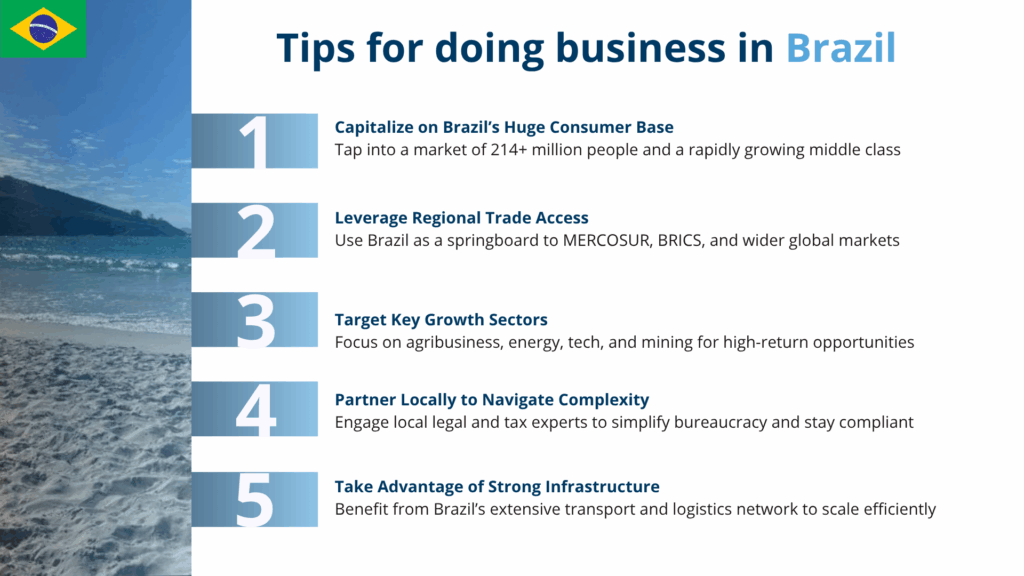
Investing in Brazil in 2026: a practical guide for European and Swiss companies\n\nBrazil, the economic giant of Latin America representing about 70% of MERCOSUR's GDP, continues to attract foreign investors despite a sometimes complex environment. With the upcoming implementation of the EU-MERCOSUR trade agreement and an economy showing signs of recovery, 2026 could be a pivotal year for European and Swiss companies looking to establish or expand their activities in this market of over 215 million people.\n\n### Why invest in Brazil?\n\nBrazil offers a unique set of opportunities for investors:\n\n* **A huge domestic market:** The size of its population and a growing middle class represent considerable consumption potential.\n* **Abundant natural resources:** The country is a world leader in agribusiness, minerals and energy.\n* **A diversified industrial sector:** Brazil has a solid industrial base, particularly in the automotive, aeronautics, chemical and consumer goods sectors.\n* **A booming innovation ecosystem:** São Paulo and other major cities are home to a growing number of startups and technology hubs, particularly in fintech, agritech and e-commerce.\n* **An ambitious energy transition:** Brazil is already a world leader in renewable energies (hydroelectricity, wind, solar) and offers huge opportunities in the green economy.\n\n### Key sectors for investment\n\nSeveral sectors stand out for their growth potential in 2026:\n\n* **Agribusiness and agricultural technology (Agritech):** Production optimisation, logistics and sustainability are key areas.\n* **Renewable energies:** Solar and wind power, as well as green hydrogen production, are booming.\n* **Infrastructure:** Significant needs in transport, sanitation and logistics offer opportunities for public-private partnerships (PPPs).\n* **Technology and Fintech:** The digitalisation of the Brazilian economy is continuing at a rapid pace, creating strong demand for technological solutions and innovative financial services.\n* **Health:** The ageing population and a growing demand for quality health services are driving investment in this sector.\n\n### The legal and tax framework\n\nInvesting in Brazil requires a thorough understanding of its regulatory framework. Although reforms have been undertaken to simplify the business environment, challenges remain.\n\n* **Legal framework:** Brazilian law applies uniformly to domestic and foreign companies. It is essential to surround yourself with local legal advisors to navigate the complexity of the system.\n* **Tax system:** The Brazilian tax system is notoriously complex, with a multitude of taxes at the federal, state and municipal levels. A tax reform has been under discussion for years and could bring simplifications in the future.\n* **Labour law:** Brazilian labour law is very protective of employees. A 2017 reform introduced more flexibility, but it remains essential to have a good understanding of your obligations as an employer.\n\n### Practical steps for investing\n\n1. **Market research:** Conduct in-depth market research to validate the potential of your product or service.\n2. **Business plan:** Develop a solid business plan, including a market entry strategy, financial forecasts and a risk analysis.\n3. **Legal structure:** Choose the most appropriate legal structure for your company (e.g., a *sociedade limitada* or a *sociedade anônima*).\n4. **Company registration:** Complete the registration procedures with the competent authorities, including obtaining a tax identification number (CNPJ).\n5. **Opening a bank account:** Open a bank account in the name of the Brazilian company.\n6. **Compliance:** Ensure compliance with all applicable regulations, including licences, permits and tax and social obligations.\n\n### Risks to consider\n\n* **Economic and political volatility:** The Brazilian economy can be subject to fluctuations and the political environment can be unstable.\n* **Bureaucratic complexity:** Bureaucracy, known as the "Custo Brasil" (Brazil cost), can be a major obstacle.\n* **Exchange rate fluctuations:** The Brazilian real (BRL) can be volatile, which can affect the profitability of investments.\n* **Legal uncertainty:** Although efforts are being made to improve legal certainty, unexpected regulatory changes can occur.\n\n### Key takeaways for investors\n\n* **Do your homework:** Thorough preparation and a good understanding of the local market are essential.\n* **Surround yourself with local partners:** Collaborating with local lawyers, accountants and consultants is essential.\n* **Take a long-term view:** Success in Brazil requires patience and perseverance.\n* **Be flexible:** The ability to adapt to a constantly changing environment is a major asset.\n\nDespite the challenges, Brazil remains an attractive destination for European and Swiss investors. With a well-thought-out strategy and good execution, the growth opportunities in this dynamic market are immense.

For a personalized analysis of your situation, do not hesitate to contact us. The first consultation is free and without obligation.

Related tool

Brazil profile

Access

Receive our analyses directly in your inbox

Join professionals who follow MERCOSUR news. 1 email per week, unsubscribe in 1 click.

Comments (0)

Leave a comment

Your email will not be published. Comments are moderated.

Stay informed about agreement developments

Receive our regulatory monitoring and exclusive analyses directly in your inbox.

Bonus: receive our PDF guide '10 steps to prepare your business for the EU-MERCOSUR agreement'

No spam. One-click unsubscribe. Data protected (GDPR/nFADP). · 1-2 emails per month