Analysis2026-03-10

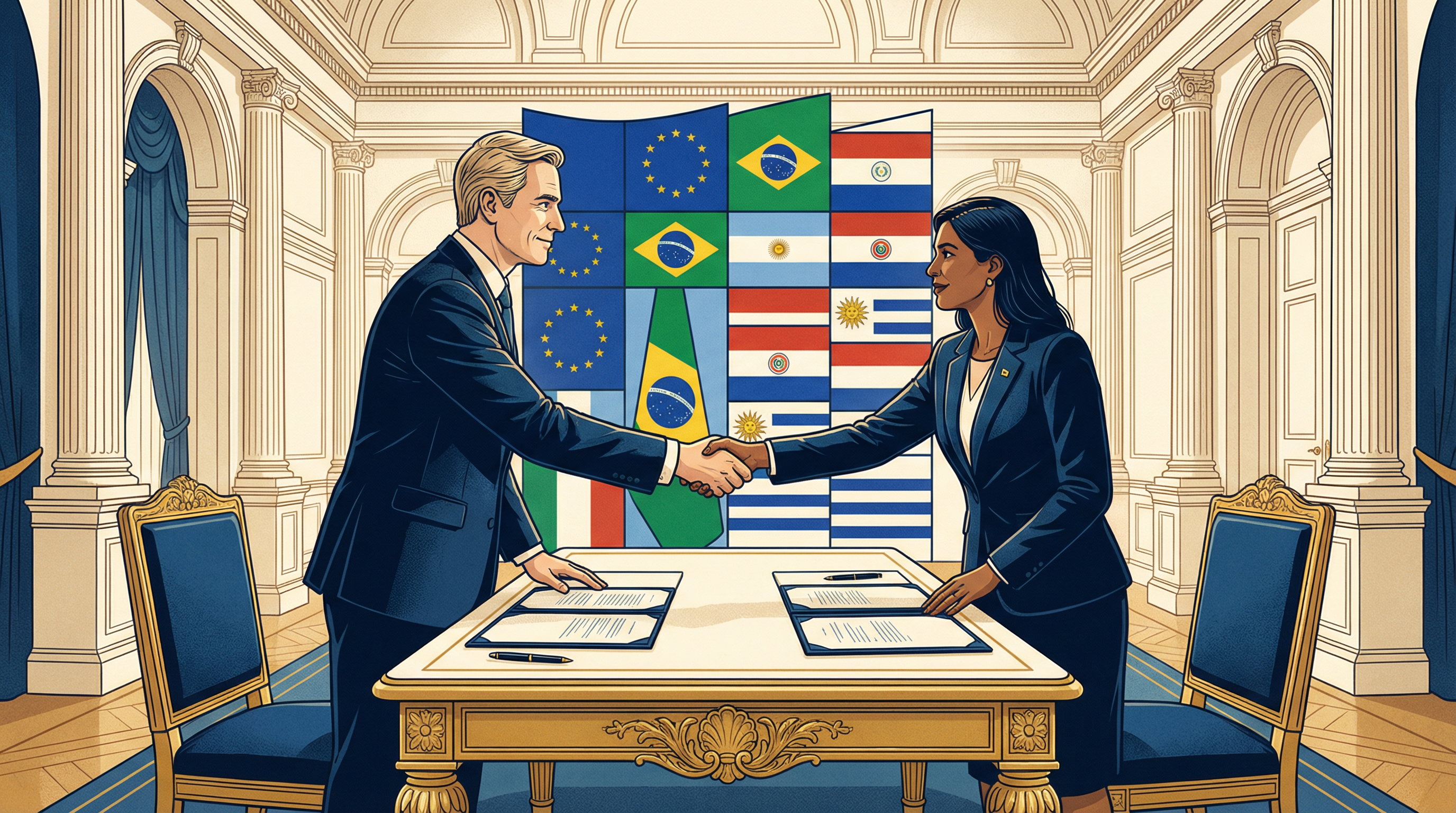
One of the most significant and often underestimated components of the trade agreement between the European Union (EU) and MERCOSUR is the reciprocal opening of public procurement markets. For the first time, European companies will have guaranteed and transparent access to a multi-billion euro market, allowing them to bid for public contracts in MERCOSUR countries (Argentina, Brazil, Paraguay, Uruguay) on an equal footing with local companies. This breakthrough represents a major transformation, creating substantial opportunities for EU suppliers of goods and services.
This guide analyzes the key provisions of the public procurement chapter, the covered entities, the applicable thresholds, and the procedures for European companies to successfully navigate this new competitive landscape.
The public procurement chapter of the EU-MERCOSUR agreement aims to establish a predictable and transparent environment based on the principles of national treatment and non-discrimination. In practice, this means that EU companies cannot be treated less favorably than domestic companies when bidding for a public tender covered by the agreement. Furthermore, MERCOSUR procuring entities cannot discriminate against a European company because of its origin.

Key obligations under the agreement include:
* Publication of Tenders: All covered procurement opportunities must be published on a single, freely accessible electronic portal. This ends the need to monitor multiple, often opaque, national or local information sources. * Transparency of Procedures: The rules of the tender, selection, and award criteria must be clear, objective, and communicated in advance. * Sufficient Timeframes: Companies must be given a reasonable amount of time to prepare and submit their bids, ensuring fair competition. * Remedies: Companies that believe the rules have not been followed must have access to swift and effective review mechanisms to challenge award decisions.
These provisions are largely inspired by the World Trade Organization's (WTO) Government Procurement Agreement (GPA), although MERCOSUR is not yet a member. The agreement with the EU is therefore a crucial step towards aligning MERCOSUR with international procurement standards.
Access is not unlimited. The agreement precisely defines which procuring entities are subject to the rules and from what value (thresholds) contracts must be opened to international competition.
* Covered Entities: * Central Government: Ministries and federal agencies of the four MERCOSUR countries are included. Brazil's federal procurement market alone, for example, is worth over €8 billion annually. * Sub-central Entities: A specific list of state or provincial-level entities is also covered, although coverage may be less extensive than at the central level. * Other Entities: Certain state-owned enterprises and entities operating in specific sectors (e.g., water, energy, transport) are also included in the scope of the agreement.
* Applicable Thresholds: The agreement's obligations only apply to contracts with an estimated value exceeding a certain threshold. These thresholds are expressed in Special Drawing Rights (SDRs) to ensure stability despite exchange rate fluctuations and are aligned with those of the GPA. As an indication: * Supply and Service Contracts (central entities): 130,000 SDR * Construction Works Contracts (central entities): 5,000,000 SDR * Thresholds for sub-central and other entities are generally higher.
Companies must systematically check if the procuring entity and the estimated value of the contract fall within the scope of the agreement to know if they can invoke the associated rights.
The agreement standardizes procurement procedures, promoting clarity and fairness. The authorized types of procedures are open tendering, restricted tendering, and, in limited circumstances, negotiated procedures.
One of the most significant changes is the prohibition of "local preference" practices, which in the past systematically favored domestic suppliers, even when their bids were less competitive.
Many sectors are now open to European competition, including:
* Infrastructure and Construction: Road, rail, port, and airport projects. * Information and Communication Technologies (ICT): Software, hardware, telecommunication services. * Energy: Equipment for energy production and distribution. * Pharmaceuticals and Medical Equipment. * Consulting Services: Engineering, architecture, legal, and financial services.
However, some exclusions and exceptions remain, particularly for reasons of national security or to protect nascent industries. It is therefore essential to carefully examine the agreement's annexes for each country.
For companies accustomed to bidding in GPA member countries, the framework of the EU-MERCOSUR agreement will seem familiar. However, there are notable differences:
| Feature | EU-MERCOSUR Agreement | WTO Government Procurement Agreement (GPA) | | :--- | :--- | :--- | | Members | EU and MERCOSUR | 48 WTO members (including the EU, but not MERCOSUR countries) | | Coverage | Focused on federal/central entities, with more limited sub-central coverage. | Often broader coverage at the sub-central level for many members. | | Sustainable Development | Contains provisions allowing for environmental and social considerations in award criteria. | Provisions on sustainable development are less explicit and depend on each member's interpretation. | | SMEs | Includes specific provisions to facilitate the participation of small and medium-sized enterprises (SMEs). | Fewer specific provisions for SMEs, although transparency benefits all. |
To capitalize on these new opportunities, European companies should:
In conclusion, the opening of MERCOSUR's public procurement markets is one of the most concrete gains of the agreement for European companies. It ends decades of protectionism in this area and establishes a rules-based framework. Success will depend on the ability of companies to embrace these new rules, identify the right opportunities, and position themselves competitively in this promising market.
For a personalized analysis of your situation, do not hesitate to contact us. The first consultation is free and without obligation.
Related tool
Business guide
Join professionals who follow MERCOSUR news. 1 email per week, unsubscribe in 1 click.
Receive our regulatory monitoring and exclusive analyses directly in your inbox.